Wales’ Private Dentistry Boom Becomes a Business Story
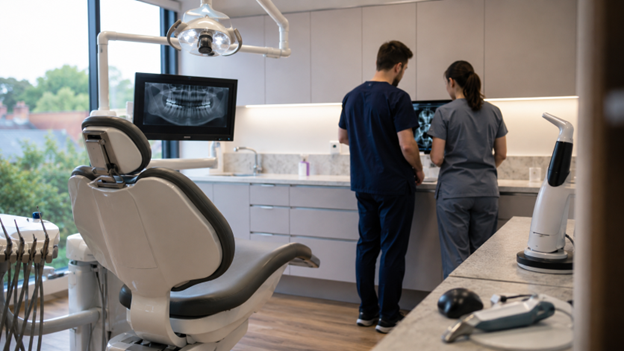
NHS dental access remains under severe pressure across Wales, but dentistry itself is not in retreat. A growing private market is reshaping practices, investment and patient choice.
A familiar high-street sector is being rebuilt
A quiet structural shift is reshaping one of Wales’ most familiar high-street sectors. NHS dental access has reached one of its most difficult points in a generation, yet the dental industry is anything but in decline. Across Cardiff, Swansea, Newport and wider Wales, private practices are expanding, being acquired, hiring and investing.
Access pressures are reshaping the market
BDA Cymru has repeatedly warned that NHS dentistry in Wales is at a tipping point, with practices handing back contracts and patients facing long waits or no routine NHS access in some areas. Welsh Government figures show just over one million adults were treated by an NHS dentist in the 24 months to 30 June 2025, equal to 40.1% of the adult population.
That pressure is helping normalise private alternatives. Cardiff is one of the clearest examples. Cedars Dental, a long-established private dentist in Cardiff on Fidlas Road in Llanishen, was acquired in 2020 by Cardiff-trained dentists Dr Nitin Duggal and Dr Chris Truman. Since then, the practice has invested in technology, expanded its team and grown private treatment across crowns, implants, orthodontics and cosmetic dentistry.
Contract pressures are forcing difficult choices
For many practices, demand is not the issue. The harder question is whether NHS contract income can cover staffing, compliance, equipment, energy, indemnity, consumables and clinical time.
The Welsh Government has announced a 4% uplift to NHS dental contract values for 2025-26, worth £9.8m, but BDA Cymru has warned that reform must not transfer more risk to practices. NHS-heavy surgeries now face a narrowing set of options: continue under pressure, move towards mixed or private care, or sell.
Private care is becoming more mainstream
Private dentistry is increasingly viewed as part of regular health, confidence and wellbeing spending, not only as a cosmetic choice. Monthly plans, including in-house schemes, Denplan and Practice Plan-style models, have made private care easier for some households to budget for.
The growth categories are broad. Invisalign, composite bonding, whitening and facial aesthetics increasingly sit alongside routine check-ups and hygiene. Crowns, bridges and implants are also more commonly delivered privately as NHS availability contracts.
The pattern varies across Wales
Cardiff and the Vale have seen the strongest private practice activity, with independent operators and corporate buyers both active. Swansea is also seeing growth, especially in cosmetic and restorative work.
Newport, Bridgend, Caerphilly and the Valleys face a more complicated picture, where NHS access pressure is significant, but affordability remains more sensitive. Rural and West Wales continue to struggle with access, while parts of North and mid-Wales have limited specialist private provision, creating gaps for future investment.
Welsh-trained dentists are part of the shift
The workforce story is central. Dentists qualifying from Cardiff Dental School and elsewhere are increasingly looking at private or mixed practice, where longer appointments and broader clinical work can be more achievable.
Dr Chris Truman, Co-Principal at Cedars Dental, said: “Patients want consistent, high-quality care from a team they know and trust. Increasingly, many are finding that through the private sector by necessity rather than preference.
“Private dentistry is not simply about offering more treatments. It requires investment in technology, training and clinical breadth.
“The next decade will be defined by how Welsh private dentistry scales responsibly to meet demand that the NHS system is no longer structured to absorb.”
Investors, suppliers and patients are all affected
For investors and acquirers, Welsh private dentistry offers recurring demand and clear growth potential. Christie & Co’s Dental Market Review 2025 reported a continued appetite for private and mixed practices, with 68% of accepted offers in 2024 at or above the asking price.
For suppliers, private practice investment in digital scanners, intraoral cameras, implant systems and aesthetics technology is creating a meaningful market. For patients, the picture is mixed: more choice and more membership plans, but affordability gaps remain in less affluent communities.
Wales now has two dental stories
Wales’ dentistry sector has not shrunk. It has restructured.
What looks from one angle like an NHS access crisis looks from another like a private dentistry boom. How Wales reconciles the two will define the sector clinically, commercially and politically over the next decade.
The Welsh dental story in 2026 is not one of decline. It is one part of the system rebuilding itself faster than the other can cope with.